

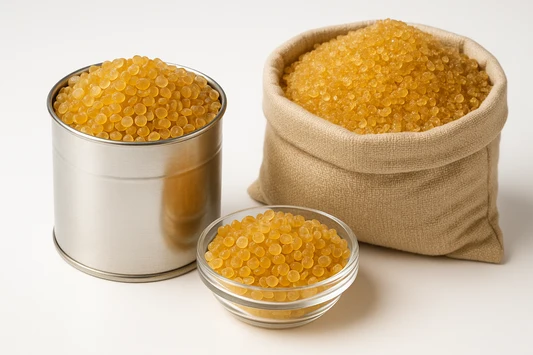
Hydrocarbon Resin
I. Product Overview
Hydrocarbon resins are thermoplastic resins polymerized from petroleum hydrocarbon monomers, belonging to low-molecular-weight polymers. They are classified into aliphatic, aromatic, etc., based on raw materials, and are widely used as tackifiers or modifiers.
II. Key Features
· Good compatibility: High adaptability with substrates like rubber and plastics, easy to mix and process.
· Excellent tackiness: Enhances the bonding strength of products, with stable low-temperature tackiness.
· Good weather resistance: Resistant to thermal-oxidative aging, adaptable to a wide temperature range (-30℃ to 120℃).
III. Common Specifications
· Types: C5 aliphatic (low color number), C9 aromatic (high softening point), C5/C9 copolymer.
· Softening point: 60-160℃ (selected by application; 80-120℃ for hot melt adhesives).
· Color number (Gardner): 1-10 (smaller value indicates lighter color).
· Molecular weight: 500-3000 (affects tackiness and fluidity).
IV. Typical Applications
· Adhesives (hot melt adhesives, pressure-sensitive adhesives), rubber products (tires, seals).
· Coatings (road marking paints, anti-corrosion paints), printing inks.